Strategy
Strategy:
Materiality and stakeholder analysis
Materiality analysis
The list of material topics is based on the double materiality assessment conducted in 2023 and thoroughly reviewed and amended in 2024 with key stakeholders, including the CEO and the Board of Directors. The assessment undergoes an annual high-level review to ensure its continued relevance and robustness. A more in-depth reassessment will be carried out whenever significant changes occur that could affect material impacts, risks, or opportunities. Such changes could include major acquisitions, shifts in business activities, substantial changes in the supply chain, global events affecting human rights, new scientific insights, or societal expectations that alter the relevance or severity of sustainability issues.
In line with the European Financial Reporting Advisory Group (EFRAG) guidance, the UN SDGs and supported by internal analyses, we initially identified 80 potentially material topics. These were consolidated into 21 topics and assessed in a survey of 63 stakeholders – including employees, suppliers, customers, and members of the Executive Board – who rated each topic on a scale of 1 to 5 for likelihood and severity of impact, or financial impact (for risks and opportunities), over a five- to ten-year horizon. The survey results were then compared with internal priorities to avoid bias and to develop the materiality matrix, which has played a central role in shaping Zehnder Group’s sustainability strategy.
In 2024, a TCFD analysis was conducted, enabling a detailed assessment of climate-related risks and opportunities. Taking this into account, the financial implications of climate change were outlined, and strategic adjustments were implemented with a focus on resilience and climate protection measures. Feedback from leadership and a benchmark against industry peers led to the validation of the data collection process, a reassessment, and the reorganisation of specific subtopics. This resulted in improved prioritisation and effectiveness.
Building on these insights, the materiality assessment continues to guide how we prioritise and address sustainability topics, ensuring alignment with stakeholder expectations and internal objectives.
Materiality Matrix
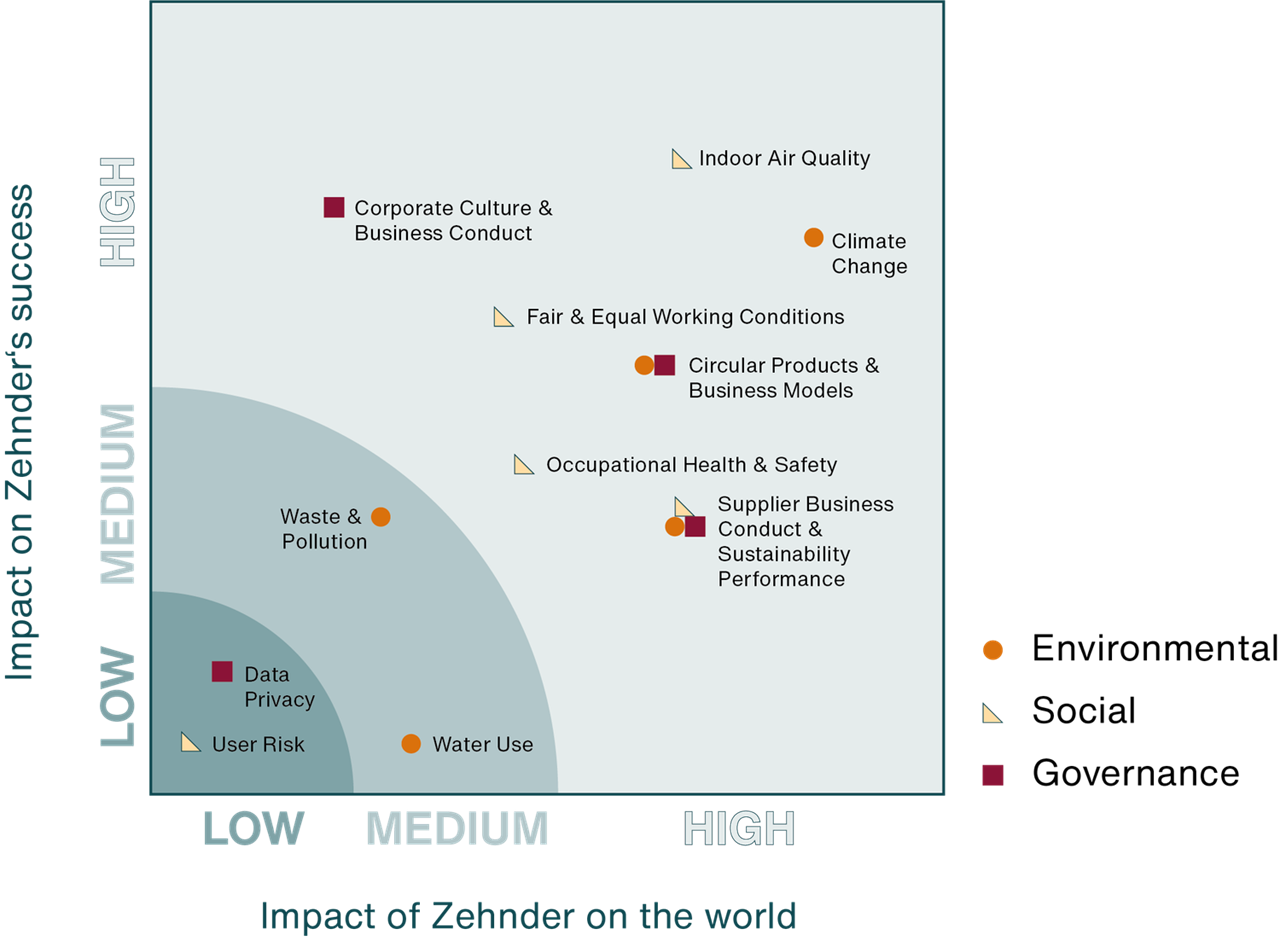
Indoor air quality (IAQ) is a key topic for Zehnder Group, given the company’s focus on mechanical ventilation systems. Good air quality has a positive effect on health and well-being and helps reduce pollutants and humidity in buildings. At the same time, energy-efficient ventilation systems help reduce the ecological footprint. IAQ is an integral part of Zehnder Group’s core business, offering our customers significant benefits through our products. Stakeholders have increasingly emphasised its importance in interviews. Although it was identified as relevant in the materiality analysis, it does not present a distinct sustainability challenge and is therefore not discussed in detail in this report.
Our other material topics remain unchanged from 2024 and are thoughtfully integrated and reflected throughout the report as follows:
- Climate action: addresses Climate Change, including our emissions, energy savings via heat recovery ventilation, and the management of physical and transition risks.
- Resource-efficient production: covers Waste & Pollution management, including packaging, scrap, and hazardous chemicals and addresses Water Use at key production sites.
- Circular products and innovation: emphasises Circular Products & Business Models including repairability, sustainable materials, and renovation-friendly solutions.
- Occupational health and safety: prioritises the well-being of employees, especially in environments with a strong focus on Occupational Health & Safety.
- Attractive employer: highlights initiatives to boost employee engagement and a supportive workplace culture.
- Diversity, equal opportunity, inclusion, and decent work: addresses Fair & Equal Working Conditions, including pay equity, diversity and inclusion, and anti-harassment measures.
- Sustainable purchasing: focuses on Supplier Business Conduct & Sustainability Performance, emphasising alignment with our ethical standards.
- Compliance and fair business practices: promotes Corporate Culture & Business Conduct by fostering transparency and compliance while preventing unethical practices.
- Upholding human rights: covers risks and due diligence efforts to ensure fair treatment in operations and supply chains.
Stakeholder analysis
Our stakeholder analysis helps us to identify important sustainability topics, recognise potential risks and opportunities and ensure that our actions are socially responsible and environmentally sustainable. This allows us to align our sustainability strategy with the expectations and concerns of those who are affected, either directly or indirectly, by our activities. Transparent communication enhances decision-making and, above all, fosters trust and builds lasting relationships.
In order to proceed with this process, we first identify our stakeholder categories by assessing their relevance to our operations, their influence on our business and the potential impact of our activities on them. Following consultations with internal teams across different branches, a preliminary comprehensive list has been compiled. We then prioritise these stakeholders based on their significance to our sustainability goals. Stakeholders include individuals and organisations with financial, legal, ethical, or environmental expectations of Zehnder Group, such as employees, customers, suppliers, investors, financial analysts, rating agencies, and non-governmental organisations.
Communication with stakeholder groups
To advance our sustainability goals, we utilise a variety of structured and inclusive approaches to engage with our different stakeholder groups, such as:
- Interviews, surveys, and workshops facilitate the collection of feedback and insights, ensuring relevance and actionable results.
- Annual and Sustainability Report along with ad hoc press releases are important media for informing shareholders and other stakeholders about key figures, sustainability initiatives, and other important topics.
- Presentations and roadshows together with conferences are important opportunities to ensure transparency, particularly towards financial stakeholders such as analysts and investors.
- Corporate governance meetings facilitate dialogue between the Chair of our Board of Directors, investors, and proxy advisors.
- Trade fairs and training sessions in addition to customer visits are ideal opportunities to interact directly with customers to exchange information and gather feedback.
- Collaboration with experts: organisations such as the UNGC can be helpful in aligning our practices with global sustainability standards.
- Supplier screening and audits are essential, as we closely collaborate with high-risk suppliers and aim to uphold our sustainable supply chain standards.