Governance
Governance:
Purpose and structure of organisation
Organisational purpose
Description of the Zehnder Group business model
Zehnder Group is a global leader in indoor climate solutions, enhancing comfort, energy efficiency and health in residential, commercial, and industrial spaces through innovative products and systems. Energy efficiency means reducing energy consumption while maintaining optimal indoor conditions, lowering costs, and environmental impact. Health and comfort are achieved by ensuring fresh air circulation, consistent temperatures, and improved air quality.
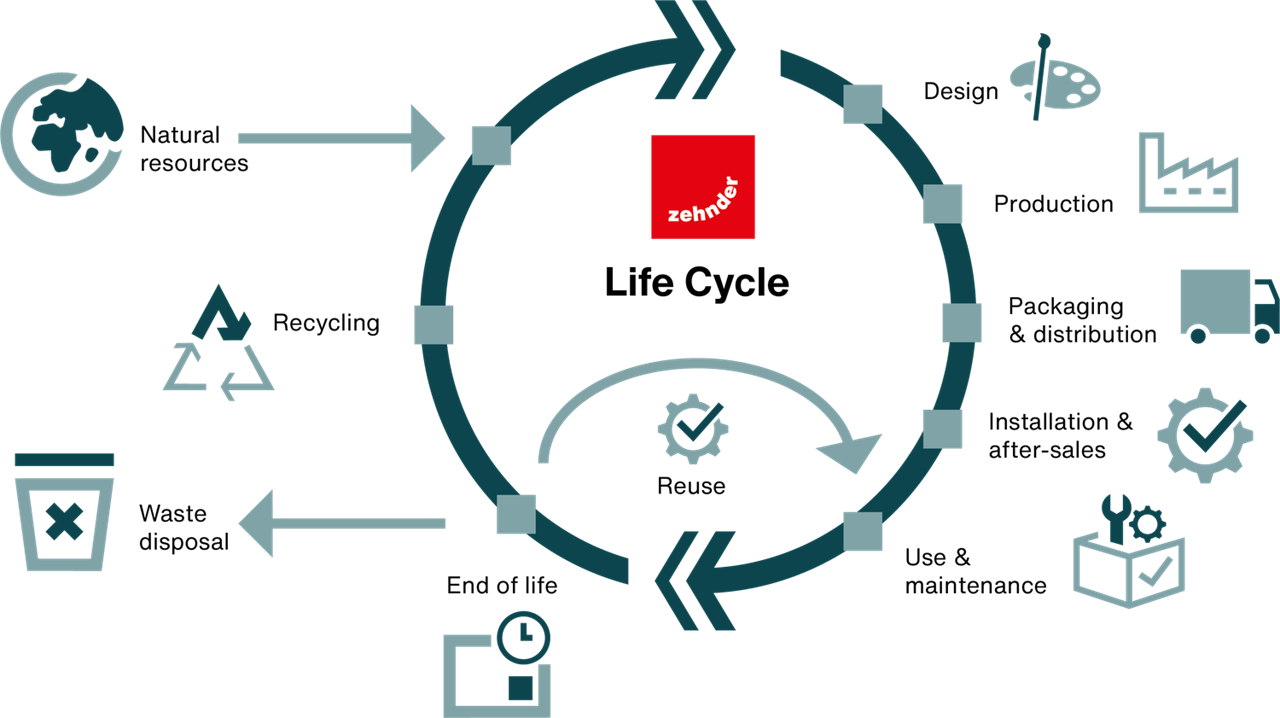
We design and manufacture our products in our own facilities across Europe, China, and North America. We have sales activities in over 70 countries through local companies and representatives. Our value chain includes acquiring raw materials, developing products, procuring materials, producing goods, distributing products, supporting customers, and disposing of goods. We have strong business relationships with suppliers, partners, and customers. Our corporate purpose is to create sustainable and long-term value and this influences both our operations and partnerships.
The Zehnder value chain
Sustainability organisation of Zehnder Group
The General Meeting is the supreme governing body of Zehnder Group. The ordinary General Meeting is held annually within six months of the end of the financial year and approves the Sustainability Report.
The Board of Directors is the highest governance body and oversees the sustainability strategy and its impacts. It comprises seven non-executive members, five of whom are considered independent under best practice standards.
The Board of Directors is supported by several committees. The Nomination and Compensation Committee manages sustainability-related remuneration and incentives, while the Audit Committee oversees sustainability- and climate-related risks within the overall risk framework. Day-to-day execution is the responsibility of the Group Executive Committee, while the Sustainability Steering Committee is responsible for developing the Group sustainability strategy.
The Chair of the Board is non-executive. Details on the Board’s composition, skills, independence, tenure, and diversity as well as the nomination and selection process are provided in the Corporate Governance Report.
Stakeholder expectations are integrated through regular materiality work; however, an internal definition for tracking under-represented social groups is still to be developed. Subsidiaries maintain employee representation where required by local law.
Delegation of responsibility
The Board of Directors delegates the management of economic, environmental, and social impacts to senior executives.
At the centre of this governance structure is the Sustainability Steering Committee. Chaired by the CEO, it includes the Chair of the Board of Directors, the Group Executive Committee, and other senior management members. It meets monthly to serve as the primary decision-making body for sustainability strategy and defines targets, approves the measures required to achieve them, and ensures alignment with corporate objectives, while fostering cross-functional collaboration among leaders.
Within this framework, the Group Executive Committee develops and implements the sustainability strategy and sets the corresponding objectives, integrating them into planning and execution across business units and functions. Reporting directly to the CEO, the Group Sustainability Manager is responsible for leading the company’s sustainability efforts. Supported by two team members, the Group Sustainability Manager is responsible for overseeing data collection, reporting on sustainability performance, and presenting an annual review to the Board of Directors and the Group Executive Committee. The Competence Centres and business leaders implement measures in their respective domains, consolidate KPIs from production sites, and submit regular progress reports to the committee.
Other Group Functions that are not directly part of the Sustainability Steering Committee but are represented by the CFO, such as Legal and Compliance, Finance and Controlling, and Group Procurement, are closely involved in implementing the strategy and driving the actions required to meet the Group’s sustainability targets.
Oversight of sustainability impacts, controls, and risk management
Sustainability is a standing Board agenda item, discussed at least twice a year, with regular KPI reports and an annual review of results and progress against targets. Zehnder Group operates an Internal Control System (ICS) that helps to ensure proper financial reporting, reliable bookkeeping, compliant and efficient operations, and to manage and mitigate risks. It also covers the assessment of selected sustainability data and is supplemented by Business Unit reviews and internal and external audits to assure information quality and reliability. Risk management follows the Group Risk Manual: each legal entity conducts an annual assessment, the Group monitors long-term meta-risks, a consolidated assessment is submitted to the Board and Internal Audit formally reports significant findings. The Board and the Group Executive Committee also conduct a joint annual review of sustainability impacts, risks, and opportunities, supported by ongoing KPI reporting.
Reviewing and approving the information
The Board of Directors reviews and approves the reported information, including the organisation’s material topics, following a structured, multi-level process: local data collection and validation by sustainability ambassadors, oversight by Group Controlling and Group Sustainability, approval by the Group Executive Committee, and final submission to the Board.
Expanding the collective knowledge
Zehnder Group aims to enhance the Board of Directors’ knowledge and expertise in sustainability, ensuring it is integrated into the corporate strategy. Sustainability expertise is a criterion for recruitment. Five of the seven board members contribute relevant sustainability insights from other boards, and four external members have completed seminars and training courses. The Board’s knowledge is further enhanced through regular learning initiatives and a biennial self-assessment that incorporates sustainability.
Prevention and mitigation of conflicts of interest
Zehnder Group has clear procedures to prevent and manage conflicts of interest. These are outlined in the Articles of Association, the Organisational Regulations, and the Code of Conduct. They detail all of the responsibilities. External engagements of Board and Group Executive Committee members are also limited by statutory rules, ensuring Board members’ duties remain aligned with the Group’s interests.
Board members and senior executives, along with all employees, must avoid any conflicts of interest with Zehnder Group. They must notify the Chair of the Board of Directors in writing if there is a potential conflict. If the conflict involves the Chair, the notification is directed to the Vice-Chair. The Chair (or Vice-Chair) assesses the situation and informs the Board of Directors if needed, recommending actions. In urgent cases, immediate measures can be taken and later reported to the Board of Directors.
To ensure transparency, all conflict disclosures and actions are documented. Zehnder Group discloses material conflicts of interest to stakeholders, when necessary, e.g. cross-board memberships, business dealings between the company and governing bodies, or related parties. These transactions are conducted at arm’s length to ensure fairness and transparency.
Communication of critical concerns
Critical concerns are reported to the Board through defined channels, ensuring transparency in the handling of sustainability, risk, and compliance issues. The Audit Committee reviews significant risks, including compliance, legal and sustainability matters, and receives an annual compliance report. The Chair of the Committee, the Group General Counsel, and the Head of Group Internal Audit maintain continuous contact in order to escalate urgent legal or regulatory issues to the highest level.
Employees and external stakeholders can raise concerns via internal reporting channels (e.g. compliance breaches or operational risks). These are escalated to senior management and, if material, to the Board. The Board also receives briefings from the Sustainability Steering Committee on environmental, social, and economic risks. The number and nature of critical concerns in the reporting year are presented under Compliance and fair business practices.